
English
Discover Roche Claire, the ideal spring water for babies: pure, low in minerals, alkaline, and free from dry residue and nitrates.

When we’re preparing a bottle for our baby, we want clear guidelines: water that’s safe, suitable and easy to choose. Yet, on the shelf, the labels can seem rather technical: nitrates, minerals, dry residue, pH… And as parents, we don’t want to have to second-guess ourselves with every bottle.
The good news is that by understanding a few key points, we can choose a bottle of water for our baby with complete confidence.
In this article, we explain where to look for the phrase ‘suitable for infant feeding’, how to check nitrate levels, why the dry residue should be low (guideline: < 500 mg/L) and how pH can be a useful indicator for babies prone to reflux (GOR).
Not all water is the same. Its composition varies depending on the source, the terrain and the collection method. And for a young child, this is particularly important: their kidneys are still developing, and before they start eating solid foods, the water used in their bottles makes up a significant proportion of their diet.
Where the quality of tap water cannot be guaranteed, ANSES recommends using a suitable bottled water from your baby’s very first months.
Roche Claire water meets these requirements and can be used with complete confidence to prepare your baby’s bottles and meals.
Reading a label therefore means:
Unlike tap water, also known as mains water, whose potability can vary depending on the water supply network, pipework or local conditions, bottled water intended for infants meets specific health and safety requirements and undergoes regular checks.
Reading a label carefully is therefore also a simple way to ensure the safety of the water you give your baby.
On a bottle of baby water, the most important statement to look out for is: ‘suitable for feeding infants’
This is usually found:
This statement means that the water meets strict regulatory requirements (microbiological and physico-chemical criteria, and authorised claims).
In practice: if this statement does not appear on the label, we avoid using this water for babies.
Nitrates are substances that occur naturally in the environment. Their concentration may increase as a result of the use of agricultural fertilisers or soil pollution. Their concentration is stated on the label in mg/L.
For water to be suitable for infant feeding : Nitrates ≤ 10 mg/L
In the body, some nitrates can be converted into nitrites. In infants, these nitrites can reduce the blood’s ability to carry oxygen.
Possible (rare) symptoms:
In the analytical composition : Nitrates (NO₃⁻): X mg/L
Minerals (calcium, magnesium, sodium, sulphates, fluoride, etc.) are beneficial to the body. In infants, most of their intake already comes from breast milk or infant formula.
Water that is too high in minerals can increase the workload on kidneys that are not yet fully developed.
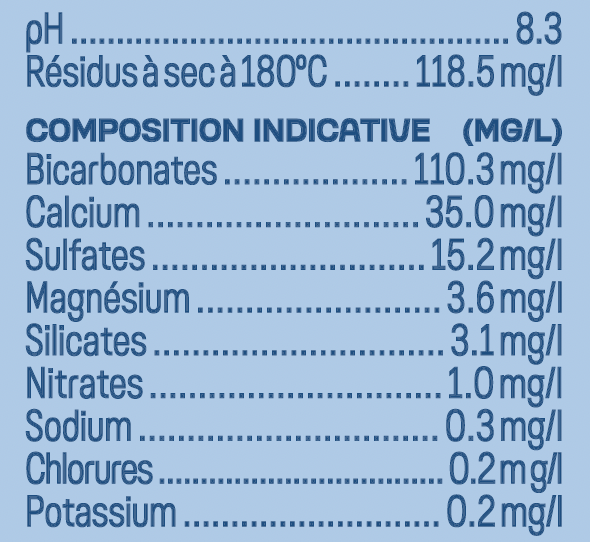
The dry residue is the total quantity of minerals remaining after the water has evaporated (measured at 180°C). Dry residue at 180°C: X mg/L
For an infant: Dry residue < 500 mg/L
➡️ A low-mineral-content water, suitable for baby bottles and enjoyable for the whole family.
The pH indicates whether water is acidic, neutral or alkaline:
Some families have noticed that slightly alkaline water is sometimes better tolerated by babies prone to reflux. This is never a substitute for medical advice.
With a pH of 8.3, Roche Claire is an alkaline water that may be worth considering for some sensitive babies.
At Roche Claire, we help parents make confident choices:
And because every baby is unique: in the event of specific medical advice, we always recommend seeking the advice of a healthcare professional.

To find out more, we invite you to discover Roche Claire water at www.eau-rocheclaire.com and our advice for new parents: simple, reliable and reassuring guidance for the whole family’s day-to-day life.
Discover Roche Claire, the ideal spring water for babies: pure, low in minerals, alkaline, and free from dry residue and nitrates.
Understanding dry residue and choosing a low-mineral-content water that is suitable for babies’ needs, it’s that simple.
Find out why Roche Claire water, which is pure and has a low mineral content, is ideal for babies from birth.